home/ plants/ indiangrass

// SPECIES PROFILE · GRASS · NATIVE

Indiangrass

Sorghastrum nutans

Adopted as the official state grass of Oklahoma in 1972 (25 Okla. Stat. § 92.1), Indiangrass is one of the Big Four tallgrass prairie grasses — alongside big bluestem, little bluestem and switchgrass — that together built the deep black soils of the Plains. A warm-season (C4) bunchgrass standing 3–7 ft when in flower, it announces September across NE Oklahoma with a glowing bronze-gold haze of narrow plume-like panicles, the bright yellow anthers catching low afternoon light. Its diagnostic pointed, rabbit-ear-like auricles at the leaf collar — sometimes called the “rifle-sight” ligule — make it instantly identifiable even out of bloom.

// QUICK FACTS
Family
Poaceae (grass)
Subfamily
Panicoideae · tribe Andropogoneae
Photosynthesis
C4 · warm-season
Habit
Perennial bunchgrass; deep fibrous root system
Native range
E. seaboard → Rockies; S. Canada → N. Mexico
USDA hardiness
Zones 4–9 (Tulsa = 7a/7b)
Mature size
3–7+ ft in flower · ~2 ft basal foliage
Bloom
Late August – October (NE OK)
Inflorescence
Narrow plume-like panicle, 8–12 in, bronze-gold
Fall color
Rich golden-orange to copper
Sun
Full sun (intolerant of shade)
Soil
Wide tolerance: sand to heavy clay; pH 4.8–8.0
Water
Low; very drought-tolerant once established
Wildlife
Bison forage · grassland-bird cover · skipper host
State symbol
State grass of Oklahoma (1972) & South Carolina
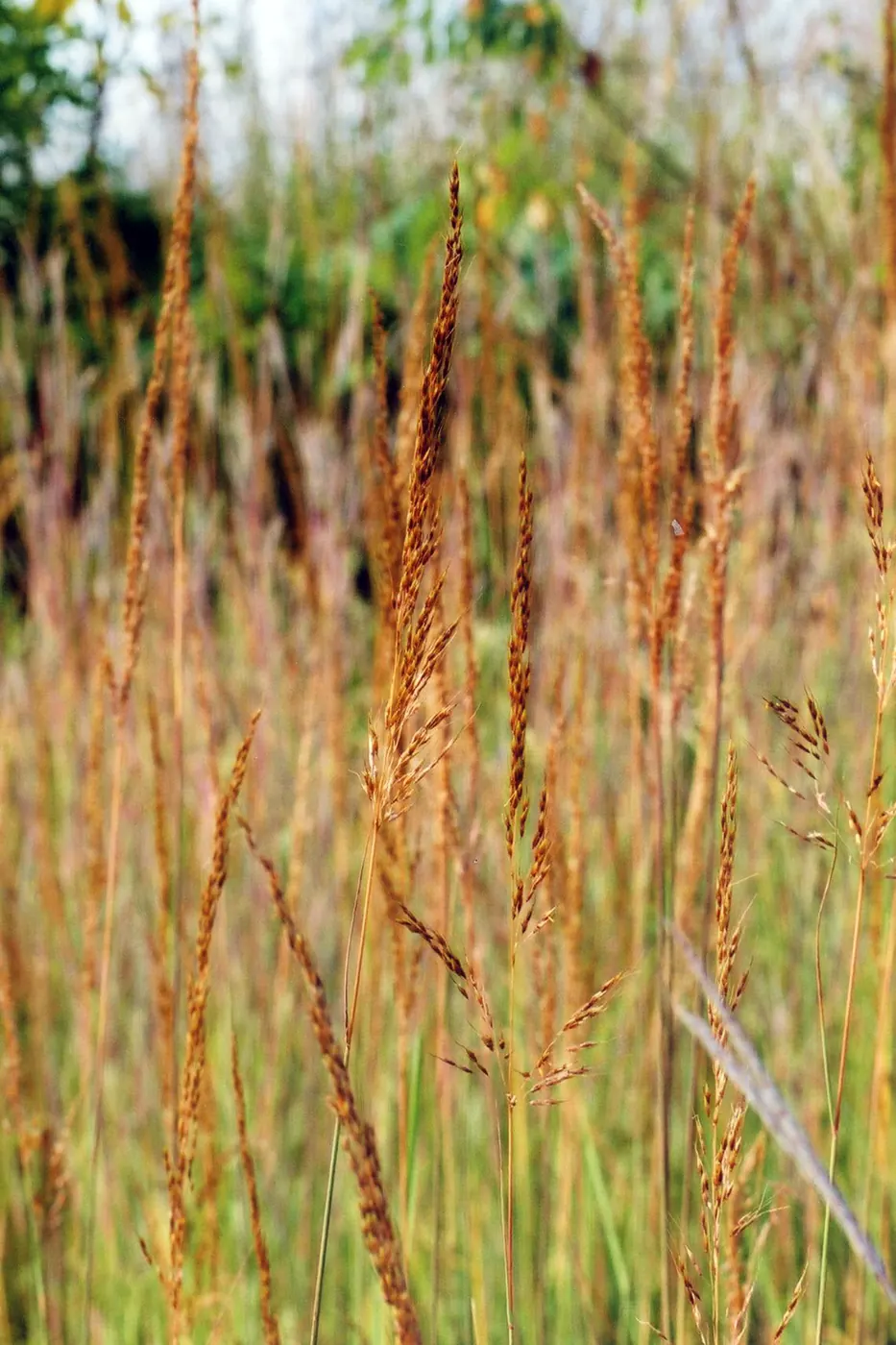
Indiangrass (Sorghastrum nutans) in late-summer flower, showing tall bronze-gold panicles
Sorghastrum nutans in late-summer flower — the moment Oklahoma's prairies turn copper-gold. Photo: USDA-NRCS PLANTS Database (Wikimedia Commons, public domain).

Identification

[ field key — habit · leaf collar · panicle · anthers · seed ]

Habit & Foliage

Erect, densely tufted perennial bunchgrass. Basal foliage forms a clump roughly 18–24" tall and wide, with leaf blades 12–36" long, ~1/4–1/2" wide, flat to slightly folded, and a distinctive blue-green to grey-green color (more glaucous in the western Plains and in selections like 'Sioux Blue'). Flowering culms shoot up rapidly in late summer to 3–7+ ft. The whole plant turns rich golden-orange to deep copper after frost and holds its color well into winter.

Leaf Collar — the Diagnostic

The single most reliable field mark for Indiangrass is the leaf collar. Where the blade meets the sheath, the membranous ligule is unusually tall and is flanked by two stiff, pointed auricles that project upward like rabbit ears — a configuration extension agronomists nickname the “rifle-sight ligule.” No other tallgrass prairie grass has this. Once you know it, you can identify Indiangrass vegetatively from a single leaf in May.

Inflorescence & Flowers

A narrow, plume-like panicle 8–12" long, opening from a tight spike to a softly arching brush of golden-bronze spikelets in late August through October. Each perfect floret bears three large, showy bright-yellow stamens dangling from the spikelet on slender filaments — en masse they make the entire prairie shimmer copper-gold in low sun. One of the two glumes at each spikelet base is densely covered in silky white hairs. Wind-pollinated; pollinated branches bend outward at maturity.

Seed & Roots

Seeds are awned caryopses (~5–9 mm including the bent, twisted awn), golden-brown, ~175,000 per pound. They drop from the panicle September through November and are dispersed by wind, gravity and grazing animals. Below ground, Indiangrass develops a deep, dense fibrous root system reaching 5–6 ft — the engine behind its drought tolerance and its outsized contribution to prairie soil-carbon storage. Short stout rhizomes can form loose colonies over time.

Habitat & Range in NE Oklahoma

Indiangrass is one of the defining keystone species of the tallgrass prairie, historically abundant across the entire Great Plains from southern Canada to north-central Mexico and from the eastern seaboard west to Montana, Wyoming and Utah. In Oklahoma it remains a dominant or co-dominant grass on intact remnants and is the structural backbone of restoration plantings statewide.

The single best place to see it at scale in NE Oklahoma is The Nature Conservancy's Tallgrass Prairie Preserve near Pawhuska in Osage County — nearly 40,000 acres of restored tallgrass with a managed bison herd and a burn-and-graze regime. By mid-September the Preserve's hills glow copper-gold from horizon to horizon, almost entirely from Indiangrass and big bluestem. Closer to Tulsa, look for it at the Tallgrass Prairie Heritage Area, on un-mowed roadsides and railroad rights-of-way, and in the transitional grasslands at the western edge of the Cross Timbers. The Black Kettle National Grassland in western Oklahoma carries it in mixed-grass prairie stands.

Indiangrass is intolerant of shade and never persists under closed canopy, but it tolerates an unusually wide range of soils — from droughty sand and chert to heavy red clay and seasonally wet bottomland — provided it gets full sun. This versatility is why it works so well across Tulsa-area landscapes that range from sandy uplands to gumbo clay yards in a single neighborhood.

Ecology & Wildlife Value

[ keystone forage · grassland birds · larval hosts · carbon ]

The Big Four

Indiangrass, big bluestem (Andropogon gerardii), little bluestem (Schizachyrium scoparium) and switchgrass (Panicum virgatum) are the Big Four of the tallgrass prairie — the four warm-season C4 perennial bunchgrasses that historically built and held the deep mollisol soils of the Plains. They are the structural and functional backbone of every legitimate tallgrass restoration; planting any one alone is a flowerbed, but planting the four together is a prairie.

Grassland Birds

The vertical structure of an Indiangrass stand — tall stems above open ground — is essential nesting and foraging habitat for declining grassland obligate birds: greater prairie-chicken, northern bobwhite, dickcissel, Henslow's sparrow, grasshopper sparrow, eastern meadowlark and the rare Cassin's sparrow (in the western mixed-grass zone). Seeds are eaten by sparrows and quail through winter; the dense bunches provide thermal cover when the prairie is dormant.

Lepidoptera Hosts

Larval host plant for the pepper-and-salt skipper (Amblyscirtes hegon), Delaware skipper (Anatrytone logan), and the imperiled Dakota skipper (Hesperia dacotae) where its range overlaps in the northern Plains. Several other skippers and satyrid butterflies feed on Indiangrass at the larval stage, and the tall stems are a favored perching and territorial-display structure for adult skippers in late summer.

Soil, Carbon & Forage

Indiangrass's deep fibrous roots — turning over annually and replenished yearly — are a major pathway for soil-carbon sequestration in tallgrass systems, and the foundation of the rich black mollisols that made the central US the world's breadbasket. As forage, young growth is highly palatable and nutritious to bison, cattle and deer; it declines in palatability after flowering, which is why prairie graziers move animals through Indiangrass stands seasonally rather than continuously.

Oklahoma state grass. Indiangrass was designated the official state grass of Oklahoma in 1972 (25 Okla. Stat. § 92.1) in recognition of its central ecological and cultural role in the state's tallgrass and mixed-grass prairies. If you are an Oklahoma native-plant gardener and you grow only one warm-season bunchgrass, this is the one to grow.
Plant the Big Four. For a complete tallgrass prairie planting in NE Oklahoma, pair Indiangrass with big bluestem, little bluestem and switchgrass in a roughly even mix, then add forbs (compass plant, prairie blazing star, purple coneflower, asters, goldenrods) at 30–40% of seed by weight. Cut everything to the ground in late winter — or, where legal and safe, do a prescribed burn, which is the management regime these grasses evolved under and respond to with renewed vigor.

Horticulture & Care

[ planting · soil · water · propagation · management · cultivars ]

Site selection & planting

Plant Indiangrass in full sun — six hours minimum, ideally all day. Shade is the only condition it will not tolerate; it thins out and disappears under any meaningful canopy. Soil requirements are otherwise broad: it grows on droughty sand, rocky chert, deep loam, and heavy red clay alike, at pH 4.8–8.0. It tolerates short-term flooding and seasonal drought equally well.

Establishment & water

Indiangrass is a slow starter. Expect most root development in years 1–2 and most flowering in year 3; do not be alarmed by a sparse-looking first season. Water new transplants weekly through the first summer, then taper off entirely. Established stands are extremely drought-tolerant and need no supplemental irrigation in NE Oklahoma in any normal year.

Annual management

Indiangrass evolved with fire. The single most important management action is to remove the previous year's growth before new shoots emerge in spring — this is what historical Plains lightning fires (and Indigenous-set fires) accomplished, and what bison-grazing reinforced.

Propagation

Pests & diseases

Effectively none of horticultural significance in landscape settings. Occasional rust and smut fungi appear on stressed stands but do not warrant treatment; ergot can occur on the inflorescence of seed-production fields. Indiangrass has no significant insect pest problem and is essentially deer-resistant once the culms harden in mid-summer.

Notable cultivars for NE Oklahoma

Cultivar Origin Distinguishing feature Notes for Tulsa
'Sioux Blue' Bluemount Nurseries (MD), 1980s Outstanding upright steel-blue foliage; ~5 ft in flower The benchmark blue-foliage cultivar; striking specimen in formal beds; division-propagated only.
'Indian Steel' Kurt Bluemel selection Steel-blue foliage, comes ~75% true from seed Less expensive seed-grown alternative to 'Sioux Blue' for larger plantings.
'Thin Man' Roy Diblik / Northwind Perennial Farm Very narrow, strictly vertical habit; ~6 ft Excellent for tight spaces, hedges and screens; holds upright in storms.
'Bluebird' Mt. Cuba Center Blue-tinted foliage with strong upright stems Reliable, less common in trade than 'Sioux Blue'.
Local ecotype seed OK / KS / N. TX origin Variable green foliage, true wild form Use this for restoration plantings, not named cultivars.

Use in the landscape

Indiangrass plays three roles in a designed planting: as the vertical structural anchor of a meadow or matrix planting; as a tall single-specimen accent in mixed beds (especially the steel-blue cultivars); and as a seasonal screen from late summer through winter. It pairs naturally with prairie forbs — Liatris, Echinacea, Silphium, Solidago, Symphyotrichum, Baptisia — and with the other Big Four grasses. Avoid mixing with aggressive cool-season grasses (fescue, brome, Bermuda), which will out-compete Indiangrass seedlings during establishment.
Forage & Cultural Uses

Indiangrass is more an emblem of the Plains than a directly-utilized human food or material plant, but its ecological and economic uses are substantial:

Photo Reference

Close-up of Sorghastrum nutans panicle showing bright yellow anthers and bronze spikelets
// Panicle close-up · golden anthers · silky-haired glumes
Wikimedia Commons
Rifle-sight ligule and pointed auricles at the leaf collar of Indiangrass
// Leaf collar · “rifle-sight” ligule · pointed auricles
Wikimedia Commons
Indiangrass leaves and basal foliage in summer
// Basal foliage · blue-green blades · bunchgrass habit
Wikimedia Commons
Sorghastrum nutans 'Sioux Blue' cultivar in landscape planting
// 'Sioux Blue' · steel-blue foliage cultivar · Bluemount Nurseries
Wikimedia Commons

Sources & Further Reading

Photos courtesy of Wikimedia Commons contributors under their respective licenses (linked under each image). Hero photo USDA NRCS PLANTS Database, public domain.

Companion Planting

[ guild · polyculture · cross-layer pairings ]

In a tallgrass prairie or pollinator meadow, indiangrass pairs naturally with: black-eyed susan (Rudbeckia hirta), cowpea / black-eyed pea (Vigna unguiculata), big bluestem (Andropogon gerardii), rocky mountain bee plant (Cleome serrulata), eastern gamagrass (Tripsacum dactyloides), and common milkweed (Asclepias syriaca).

Interplant indiangrass as a structural matrix between forbs to mimic native prairie architecture.