Horticulture & Care
[ siting · soil · water · cutback · cultivars · matrix planting ]
Site selection & planting
Plant in spring after soil warms (April–May in Tulsa) for
best establishment of this warm-season species — fall planting is possible but
riskier. Choose full sun (6+ hours direct, more is better);
anything less and the clumps stretch, weaken and flop open by August. Soil should
be well-drained and on the lean side: native subsoil, sand, gravel,
or unamended clay are all ideal. Avoid rich, irrigated bed soils — the most
common reason a Little Bluestem flops is that a gardener treated it kindly.
- Spacing: 18–24" on center for mass plantings; 12" for tight matrix.
- Hole: just wide enough for the rootball; do not amend.
- Mulch: a thin 1" mulch ring is sufficient — do not bury the crown.
- Water in well at planting and through the first dry month, then taper off.
- Do not fertilize. Lean soil = upright form & better fall color.
Water & ongoing care
After the first season, established Little Bluestem requires essentially
zero supplemental water in the Tulsa region except in the most extreme
multi-month drought. Overwatering is far more harmful than underwatering — wet
roots in summer cause crown decline and flopping.
Late-winter cutback
Cut clumps to 4–6" in late February or early
March, before new spring growth appears. Hand pruners work for a few
plants; a string trimmer or hedge shears are faster for masses. Remove or compost
the cuttings — do not leave a thatch mat over the crown. Established prairie
plantings can also be burned in late winter where local ordinances
allow.
Propagation
-
Seed: Easy. Collect ripe seed October–December; cold-moist
stratify 30 days, then surface-sow on warm soil in spring. Germination is
typically excellent. Use local-ecotype seed for prairie
restoration projects (Oklahoma or Kansas-sourced is ideal for NE OK).
-
Division: Lift mature clumps in spring as new growth begins,
slice the crown into 3–5 sections with a sharp spade, and replant
immediately. The single most reliable way to propagate a named cultivar.
Notable cultivars for NE Oklahoma
The Mt Cuba Center's landmark 2018 Little Bluestem trial
evaluated dozens of selections side-by-side over multiple years and reshaped the
ornamental-grass market. The cultivars below are the trial's top performers and the
most reliable choices for a Tulsa garden.
| Cultivar |
Origin |
Distinguishing feature |
Notes for Tulsa |
| 'Standing Ovation' |
North Creek Nurseries (NCIN) |
Tight strictly-upright form; thicker, bluer blades; stiff stems that do not flop; intense red-orange fall color. |
PPA 2022 Plant of the Year. Top performer in the Mt Cuba 2018 trial — the most garden-friendly Little Bluestem ever released. |
| 'Carousel' |
Chicagoland Grows |
Compact (~2 ft), exceptional multi-color fall stems — rose, copper, mahogany & orange on a single plant. |
Excellent for smaller residential beds; one of the Mt Cuba trial favorites. |
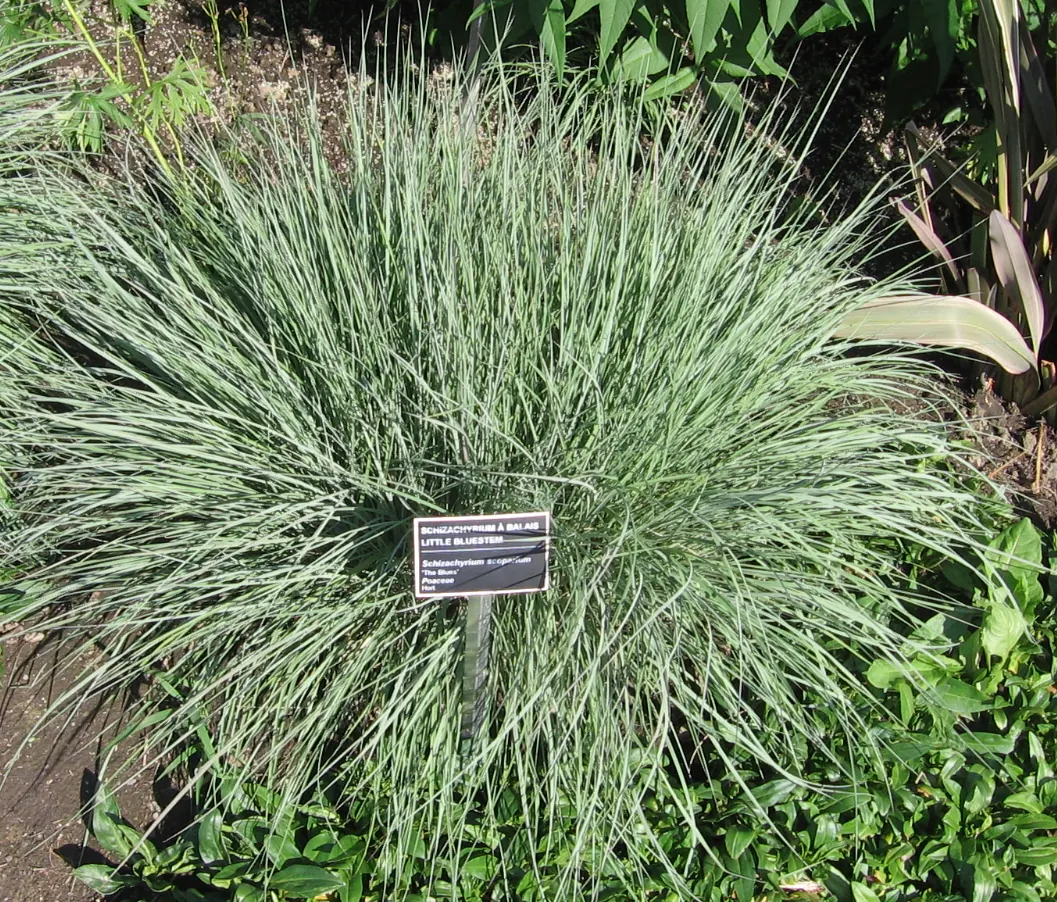
| 'The Blues' |
Limerock Plant Co. |
Strikingly intense blue-glaucous summer foliage; the bluest selection in commerce. |
Older selection; can flop on rich soil — site lean and dry. |
| 'Smoke Signal' |
Intrinsic Perennial Gardens |
Burgundy-red flush starting in midsummer; deep red-purple fall color. |
Top fall-color performer in Mt Cuba 2018; upright habit. |
| 'Twilight Zone' |
Intrinsic Perennial Gardens |
Silvery-purple summer foliage; deep purple-mauve flowering stems. |
Strong vertical form; striking in mass. |
| 'Blaze' |
USDA-NRCS Manhattan, KS |
Older release; brilliant red fall color; rangeland origin. |
Reliable, widely available; better for restoration than ornamental beds. |
| 'Prairie Blues' |
Bluebird Nursery |
Blue summer foliage; orange-red fall color. |
Older selection now largely superseded by 'Standing Ovation' and 'The Blues'. |
| Local ecotype seed |
Oklahoma / Kansas wild collections |
Genetically diverse; locally adapted; variable in form. |
The right choice for prairie restoration, large meadow plantings, and pollinator-conservation projects. |
'Standing Ovation' — Plant of the Year: Selected by North
Creek Nurseries, this cultivar was the runaway top performer in the
Mt Cuba Center 2018 Little Bluestem trial and was named the
Perennial Plant Association's Plant of the Year for 2022. Its
stiff, strictly-upright form solves the historical "flopping" problem that kept
Little Bluestem out of formal gardens, while keeping the brilliant fall color and
full ecological value of the species. Lean, dry, full-sun siting is still
required — even 'Standing Ovation' will lean if grown rich and wet.
Companion planting — the classic Tulsa prairie quartet
Little Bluestem is the matrix — the structural grass — in countless
successful NE Oklahoma garden designs. The most reliable, ecologically valuable,
and visually iconic combination for our region is:
- Little Bluestem (Schizachyrium scoparium) — structure, fall color, winter form, skipper host
- Butterfly milkweed (Asclepias tuberosa) — orange June bloom, monarch host
- Aromatic aster (Symphyotrichum oblongifolium) — lavender October bloom, late-season pollinator fuel
- Black-eyed Susan (Rudbeckia hirta) — gold July–August bloom, generalist nectar
Plant Little Bluestem at 18" centers as the matrix grass with the three forbs woven
through at one-quarter to one-third the density. The result is a 12-month
self-sustaining, low-input planting that flowers from June to hard frost and
carries copper-red structure all winter.


.jpg)

.jpg)