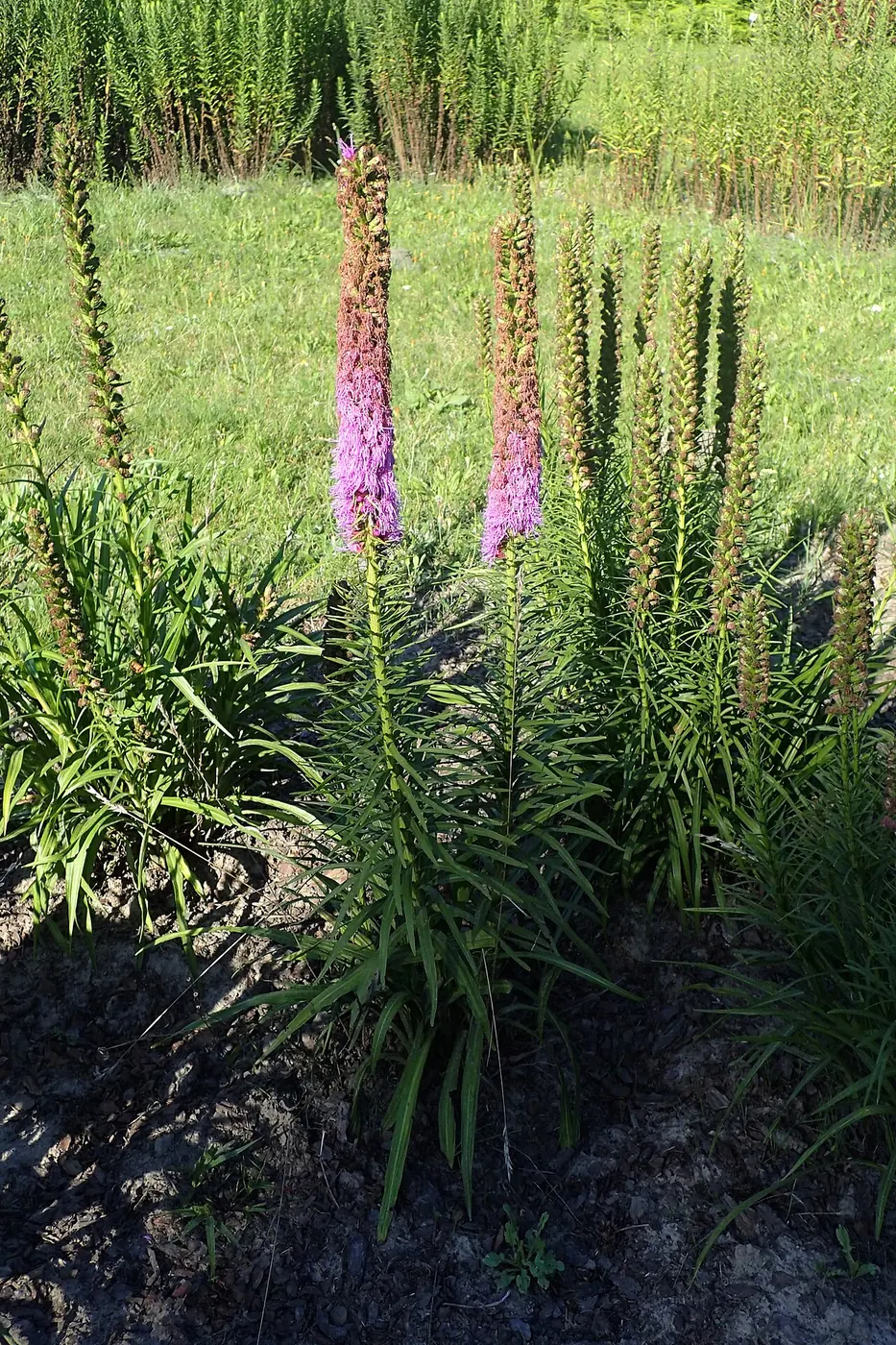
Horticulture & Care
[ planting · soil · water · propagation · pruning · pests ]
Site selection & planting
Plant Prairie Blazing Star in full sun (6+ hours direct) on
well-drained loam. It will establish in Tulsa-region clay if
drainage is reasonable and the spot does not pond water in winter — wet feet
during dormancy is the single most common cause of corm rot and stand failure.
Avoid heavily amended, over-rich beds: lush, nitrogen-fed plants on irrigated
garden soil grow tall and floppy and require staking, while plants on lean prairie
soil stand up unsupported. Spacing: 12–18 in apart for a naturalistic drift.
- From corm: plant 1–2 in deep, pointed (growth) end up, fall or very early spring while dormant.
- From container: plant in spring or fall at the same depth the plant grew in the pot; do not bury the crown.
- Mulch: a thin layer (1") of grit, gravel or coarse mulch around the crown improves drainage; avoid deep wood-mulch piles against the stem.
- Stake only on rich, irrigated sites — or better, move it to a leaner spot.
- Water in well at planting; thereafter only during prolonged late-summer drought.
Water & long-term care
Once established (after the first full growing season), Prairie Blazing Star is
notably drought-tolerant in the Tulsa region but performs best with one or two deep
soaks during the late-July/August dry stretch — this is also when the
inflorescence is forming and good moisture translates directly into a longer, denser
spike. Cut back spent stems either in late fall (for a tidy look)
or, better, in late winter (mid-February in Tulsa) so that the
seedheads feed goldfinches and the hollow stems shelter overwintering native bees.
Division & propagation
-
Corm division (best method): Every 4–5 years, lift mature
clumps in fall after the foliage yellows (early November in
Tulsa). Wash the soil away to expose the cluster of corms, then snap or cut
offsets free with a clean knife so each piece has at least one growth bud.
Replant immediately, 1–2 in deep, pointed end up. Spring division is
possible but riskier.
-
Seed: Collect achenes in October, sow outdoors immediately or
cold-stratify for 6–8 weeks at 35 °F before a spring sowing. Surface-sow
or barely cover — light improves germination. Expect first-year plants to
produce only basal foliage; flowering begins in year 2 or 3 as the corm builds size.
-
Cuttings: Not practical — Liatris does not propagate from
stem or root cuttings.
Pests & diseases
- Corm rot — the only serious problem; entirely a function of poor drainage. Plant on a slight mound or amend with grit if your site holds winter water.
- Powdery mildew — cosmetic late-season issue in shaded or crowded plantings; improved by full sun and air movement.
- Voles — will occasionally eat dormant corms; a handful of sharp gravel in the planting hole deters them.
- Schinia caterpillars — tunnel inside flower heads. This is a feature, not a bug — it means rare specialist moths are using your garden.
Liatris species comparison for Tulsa & NE Oklahoma
| Species |
Common name |
Height & spike form |
Habitat / drought |
Notes for NE OK |
| L. pycnostachya |
Prairie Blazing Star · tall gayfeather |
2–5 ft · long, dense cylindrical spike · top-down bloom |
Mesic tallgrass prairie · medium drought |
Tallest OK native; classic Tallgrass Prairie Preserve species; needs decent moisture. |
| L. spicata |
Dense (marsh) Blazing Star |
2–4 ft · dense spike · top-down · bracts flat, round-tipped |
Mesic to wet meadows · low drought |
Most common nursery Liatris; eastern in origin; tolerates wetter soils than other species. |
| L. punctata |
Dotted Blazing Star |
1–2 ft · short, dense spike · stiff & compact |
Dry uplands · highest drought tolerance |
OK native; dominant on dry roadsides & mixed-grass prairie further west; deep taproot — do not move. |
| L. aspera |
Rough Blazing Star · button snakeroot |
2–4 ft · loose, spaced flower heads · larger individual heads |
Dry sandy or rocky uplands · high drought |
OK native; latest-blooming (Sept–Oct); great companion to push the bloom window into mid-fall. |
| L. squarrosa |
Scaly Blazing Star |
1–2 ft · loose · sharply recurved (squarrose) bracts |
Dry rocky glades · high drought |
Eastern OK glades & barrens; small and tough; good for hellstrips. |
| L. mucronata |
Cusp / narrowleaf Blazing Star |
1–3 ft · slender spike · very fine grasslike leaves |
Dry calcareous soils · high drought |
Native in southern OK; uncommon in NE OK trade but worth seeking out for limestone gardens. |
|
Notable named cultivars of L. pycnostachya:
'Eureka' (improved spike density & uniformity, German selection)
and the white-flowered 'Alba'. Most cultivars sold as "Liatris"
in big-box stores are L. spicata ('Kobold', 'Floristan White',
'Floristan Violet') — check the label.
|
Companion planting in a NE OK pollinator garden
Pairs naturally with: butterfly milkweed (Asclepias
tuberosa) and swamp milkweed (A. incarnata) for the
monarch breeding host, showy goldenrod (Solidago speciosa)
and stiff goldenrod (S. rigida) for the late-season nectar
handoff, purple coneflower (Echinacea purpurea),
wild bergamot (Monarda fistulosa), rattlesnake
master (Eryngium yuccifolium), and a matrix of warm-season
bunchgrasses — little bluestem (Schizachyrium scoparium),
prairie dropseed (Sporobolus heterolepis), or
sideoats grama (Bouteloua curtipendula) — whose foliage
both supports the Liatris spikes and disguises the bare lower stems.