home/ plants/ post-oak

// SPECIES PROFILE · TREE · NATIVE · KEYSTONE

Post Oak

Quercus stellata

The Post Oak is the tree that defines NE Oklahoma. Tulsa sits in the literal heart of the Cross Timbers — a 30,000+ sq-mi belt of fire-shaped oak savanna stretching from southeastern Kansas through Oklahoma into north-central Texas — and Quercus stellata is its dominant canopy species. Slow-growing, drought-hardened, fire-adapted, and routinely living 200–400 years (with documented Cross Timbers individuals over 500), the post oak is identifiable at a glance by its leathery, cross-shaped leaf — three squared-off terminal lobes arranged like a Maltese cross. It is also one of the most common casualties of suburban development: nearly every "dying mature oak" we get called to look at in midtown Tulsa is a post oak whose root zone was compacted, regraded, or paved over years before the symptoms appeared.

// QUICK FACTS
Family
Fagaceae (white oak section)
Native range
E. & central US: MA → FL, west to TX & inland to IA
OK status
Dominant canopy tree of the Cross Timbers ecoregion
USDA hardiness
Zones 5–9 (Tulsa = 7a/7b)
Mature size
33–50 ft typical · occasionally to 90+ ft
Trunk
12–24 in dia. typical · 50+ in on old specimens
Growth rate
Slow (~6–12 in/yr in good sites)
Lifespan
200–400 yrs · documented >500 in Cross Timbers
Bloom
Catkins in April, with leaf emergence
Acorn maturity
One season (white oak group); ripe Sept–Oct
Sun
Full sun (intolerant of shade as a sapling)
Soil
Dry, sandy or rocky, low-fertility; pH 4.5–7.5
Water
Low; deeply drought-tolerant once established
Wildlife
Heavy mast for deer, turkey, squirrels; host to ~500 lepidoptera
Mature post oak (Quercus stellata) with characteristic gnarled, horizontal branching
Quercus stellata — the gnarled, horizontal-branched silhouette that dominates the ridgetops of the Cross Timbers from Turkey Mountain to the Keystone Ancient Forest. Photo: Rooted Revival.

Identification

[ field key — bark · leaf · flower · acorn · habit ]

Habit & Bark

Medium tree with a dense, rounded crown and notably stout, horizontal lower branches — often the easiest silhouette to read from a distance in winter. Trunk frequently short, crooked, and forked low; old open-grown trees develop massive lateral limbs that sweep nearly to the ground. Bark is light gray to reddish-brown, broken into shallow, scaly, rectangular plates separated by narrow fissures — a classic white-oak look, but generally rougher and more blocky than Q. alba.

Leaves

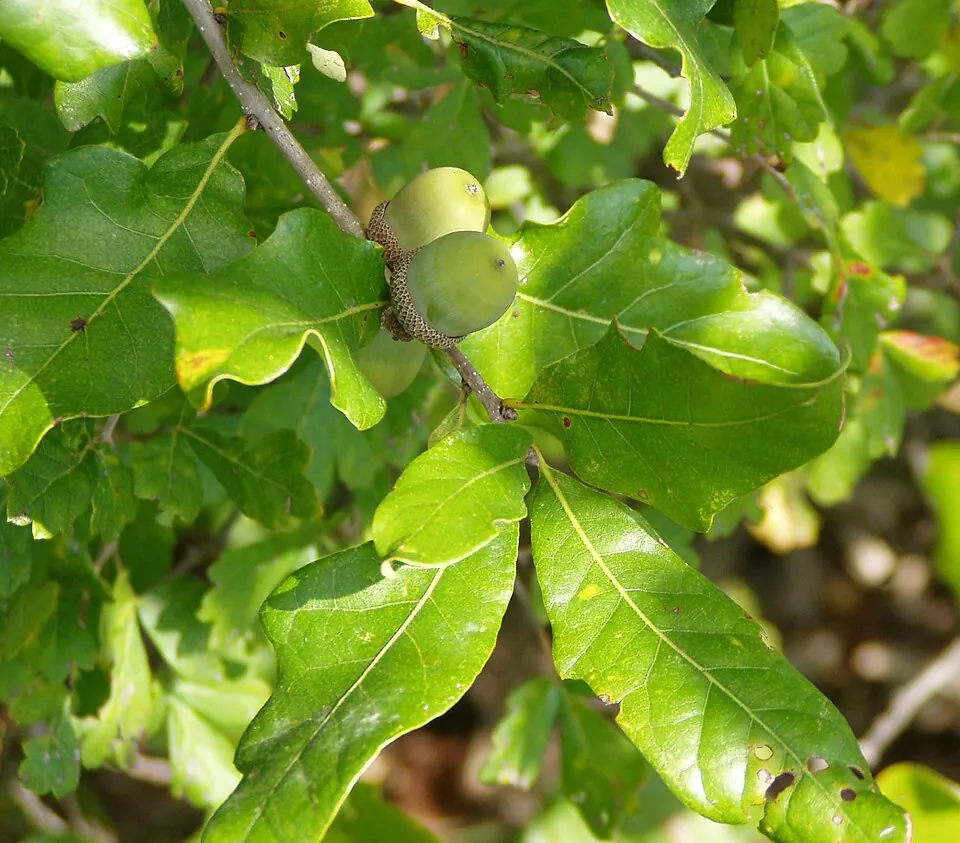
Alternate, simple, leathery, 4–15 cm long, with the most diagnostic leaf in the eastern oaks: typically five lobes arranged so the three terminal lobes form a squared-off Maltese-cross / plus-sign shape. Lobes are rounded with no bristle tips (white-oak group). Upper surface dark green and slightly rough; underside paler and densely covered in stellate (star-shaped) hairs — the trichomes that give the species its name stellata and the easiest way to separate it from white oak in hand. Fall color tan to dull russet-brown; dead leaves often persist on the tree through winter (marcescence).

Flowers

Wind-pollinated, monoecious. Male flowers in slender, drooping yellow-green catkins 5–10 cm long, released in April as the new leaves expand — a brief, heavy pollen pulse that is a significant springtime allergen across NE Oklahoma. Female flowers are tiny, reddish, in 1–few-flowered spikes in the new leaf axils, easily overlooked.

Acorns

1.5–2 cm long, ovoid, light brown, with a shallow bowl-shaped cup covering about a third of the nut and bearing tightly appressed, reddish-brown scales. Mature in a single season (white-oak group) and drop in September–October. Heavy mast crops occur every 2–4 years. Acorns are sweet relative to red-oak group acorns (lower tannin) and germinate immediately on the ground in fall; they have no chilling requirement and quickly lose viability if they dry out.

Habitat & Range in NE Oklahoma

Tulsa sits in the literal core of the Cross Timbers, the transitional oak savanna where the eastern deciduous forest meets the central tallgrass prairie. Quercus stellata is the defining canopy tree of this ecoregion, almost always co-dominant with blackjack oak (Q. marilandica) and intermixed with black hickory and eastern redcedar. On the dry sandstone and chert ridges that ring Tulsa — Turkey Mountain, Chandler Park, Joseph Williams Park (Mohawk), the Osage Hills, and the Keystone Ancient Forest west of Mannford — post oak is essentially the only deciduous tree on the upper slopes. The Keystone Ancient Forest in particular contains documented post oaks over 500 years old, individuals that were already mature when the Spanish first crossed the region.

Post oak thrives precisely where most landscape trees fail: thin, infertile, droughty, slightly acidic soils on south- and west-facing slopes. It is a poor competitor in deep, moist, fertile bottomland (where it gives way to bur oak, shagbark hickory, and pecan), and it is intolerant of any standing water. It is fire-adapted — thick bark and the ability to resprout from a lignotuber allow it to persist through the historic 1–3 year fire return interval that kept the Cross Timbers an open savanna with grass beneath the canopy. Without fire (as in nearly all of suburban Tulsa today), eastern redcedar invades and the understory closes in, eventually shading out post oak regeneration entirely.

Ecology & Wildlife Value

[ mast · larval hosts · cavity nesters · trophic role ]

Acorn Mast

Sweet, relatively low-tannin, single-season acorns make post oak one of the most important wild-food sources in the region. Heavily used by white-tailed deer, eastern wild turkey, fox squirrel, eastern gray squirrel, raccoon, opossum, blue jay, and red-headed & red-bellied woodpeckers. Blue jays in particular cache vast numbers of acorns each fall and are responsible for moving post oak seed across miles of fragmented landscape — the primary natural mechanism of long-distance regeneration. Acorns are toxic to cattle (tannin / gallic acid) when consumed in quantity, an old hazard for free-range livestock in Cross Timbers pastures.

Lepidoptera Hosts

Oaks (Quercus spp.) are the single most important plant genus for North American moths and butterflies — Doug Tallamy's research documents roughly 500+ lepidoptera species using oaks as larval hosts in the eastern US, more than any other tree genus. Notable species that feed on post oak in NE Oklahoma include Polyphemus moth (Antheraea polyphemus), Imperial moth (Eacles imperialis), Io moth (Automeris io), banded hairstreak (Satyrium calanus), white-M hairstreak (Parrhasius m-album), Edwards' hairstreak (Satyrium edwardsii), the oak leafroller, and numerous underwing (Catocala) moths. This caterpillar load is what feeds nearly every breeding songbird in the region — a single pair of Carolina chickadees feeds 6,000–9,000 caterpillars to one brood, most of them off oaks.

Cavity Nesters & Galls

Old post oaks routinely develop heart-rot and cavities — ecologically a feature, not a flaw. These cavities house screech-owls, wood ducks, fox squirrels, raccoons, and a range of cavity-nesting songbirds. Post oak also hosts a remarkable diversity of cynipid wasp galls (gouty-oak gall, horned oak gall, oak apple, woolly leaf galls), which in turn support their own food web of inquilines, parasitoids, and gall-eating birds. Galls are essentially harmless to a healthy tree.

Mycorrhizae & Soil Function

Post oak forms obligate ectomycorrhizal partnerships with a wide range of fungi (russulas, lactarius, boletes, the Cross Timbers truffle Tuber lyonii) that allow it to extract water and nutrients from droughty, infertile soils where unmycorrhized trees would die. Disturbing the soil and litter layer destroys this network — one of the reasons that transplanted post oaks rarely thrive and that root-zone construction damage is so often fatal.

Permaculture & restoration role: Post oak is a Layer 1 (canopy) keystone for any dryland NE Oklahoma planting. It is not a tree to install in a young food forest — it grows too slowly and resents disturbance — but it is the single most important tree to protect on any Cross-Timbers site you steward. Pair existing mature post oaks with under-canopy chickasaw plum, fragrant sumac, little bluestem, and Indian grass to recreate the historic open-savanna structure.

Horticulture & Care

[ root protection · planting · water · propagation · pests ]

The single most important post-oak rule for Tulsa homeowners: existing mature post oaks cannot tolerate disturbance of their root zone. Do not compact, regrade, trench, pave, or install turf irrigation inside the dripline. Do not pile fill soil over the roots — even 2–4 inches of added grade is enough to suffocate fine roots and kill a tree over the following 2–7 years. "Sudden" decline of a 200-year- old post oak is almost always traceable to construction damage, septic work, or lawn installation done years earlier.

Site selection & planting (new trees)

Plant only as a young, small container tree (1–5 gallon, ideally air-pruned or root-pruned stock) or directly from acorn. Larger B&B post oaks transplant poorly because of a deep, dominant taproot that develops in the first year. Choose a site with:

Care of existing mature trees

Propagation

Pests & diseases

Notable varieties & close relatives in the region

Taxon Status Distinguishing feature Notes for NE Oklahoma
Q. stellata var. stellata variety The typical form described above The dominant Cross Timbers post oak.
Q. stellata var. paludosa variety (delta post oak) Larger, found on Mississippi alluvial bottoms Not present in NE OK; mentioned for completeness.
Q. margarettae (sand post oak) close relative Smaller, more southern, deep sand sites Edge-of-range in southeastern OK only.
Q. × fernowi natural hybrid Q. stellata × Q. alba Occasional where ranges overlap; intermediate leaf shape.
Q. × guadalupensis natural hybrid Q. stellata × Q. macrocarpa (bur oak) Locally documented; vigorous, larger acorns.
Q. marilandica (blackjack oak) frequent associate Red-oak group; bristle-tipped, leathery, dilated leaves The other half of the "post-oak / blackjack" Cross Timbers community.

Companion planting / restoration guild

In a Cross Timbers restoration context, post oak's natural associates include blackjack oak, black hickory (Carya texana), chickasaw plum (Prunus angustifolia), fragrant sumac (Rhus aromatica), coralberry (Symphoricarpos orbiculatus), and a warm-season grass and forb layer of little bluestem, Indian grass, side-oats grama, purple coneflower, wild bergamot, and butterfly milkweed. Avoid planting cool-season turf grasses, ornamental ivies, or anything requiring summer irrigation under or near an established post oak.
Edible, Cultural & Material Uses

Acorn-eating note: Raw post-oak acorns contain enough tannin to cause stomach upset in humans (and serious illness in cattle and horses if eaten in quantity). Always leach with multiple changes of cold or boiling water until the water runs clear and the acorn meat tastes mild before eating.

Photo Reference

Mature Quercus stellata showing dense rounded crown and stout horizontal branches
// Habit · dense round crown · stout horizontal limbs
Wikimedia Commons
The Houston Campsite oak, a venerable specimen Quercus stellata in Coppell, Texas
// Veteran tree · Houston Campsite oak, Grapevine Springs Preserve, TX
Wikimedia Commons
Post oak leaves showing the diagnostic Maltese-cross terminal lobes
// Leaves · cross-shaped lobing · leathery · stellate hairs beneath
Wikimedia Commons
Gouty oak gall, a cynipid wasp gall on Quercus stellata
// Gouty oak gall · cynipid wasp · harmless to healthy trees
Wikimedia Commons

Sources & Further Reading

  • USDA NRCS PLANTS Database — Quercus stellata: plants.usda.gov/plant-profile/QUST
  • Stransky, J. J. (1990). Quercus stellata Wangenh. — Post Oak. In Silvics of North America: Vol. 2, Hardwoods, USDA Forest Service Ag. Handbook 654: srs.fs.usda.gov/pubs/misc/ag_654_vol2.pdf
  • USDA Forest Service Fire Effects Information System (FEIS) — Quercus stellata: fs.usda.gov/database/feis/plants/tree/queste
  • Lady Bird Johnson Wildflower Center — Native Plant Database: wildflower.org — QUST
  • Oklahoma Forestry Services — Cross Timbers ecoregion management publications and Keystone Ancient Forest old-growth surveys.
  • Oklahoma State University Extension — Oak Wilt in Oklahoma (EPP-7321) and Selecting Trees for Oklahoma Landscapes (HLA-6414).
  • Stahle, D. W. et al. — Ancient Cross Timbers research, including documentation of post oaks >500 years old in the Keystone Ancient Forest: uark.edu/dendro (Tree-Ring Laboratory, Univ. of Arkansas).
  • Tallamy, D. W. (2007). Bringing Nature Home; and Tallamy & Shropshire (2009), "Ranking lepidoptera use of native versus introduced plants," Conservation Biology 23(4):941–947 — ranking of Quercus as the top lepidoptera-supporting woody genus.
  • Wikipedia — Quercus stellata: en.wikipedia.org/wiki/Quercus_stellata (CC BY-SA 4.0; portions of the description and uses sections summarize Wikipedia content).
  • Irving, W. (1835). A Tour on the Prairies — the first detailed written description of the Cross Timbers post-oak savanna.

Hero photo © Rooted Revival. Reference photos courtesy of Wikimedia Commons contributors under their respective licenses (linked under each image).